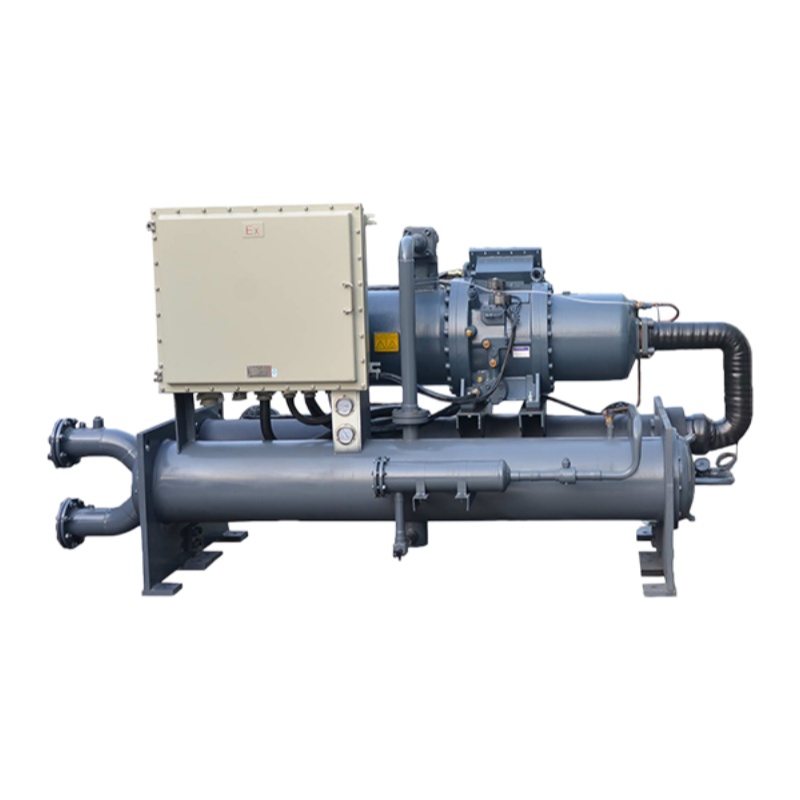
In the modern industrial landscape, maintaining precise temperature control is critical for ensuring production efficiency, product quality, and equipment longevity. This is where chiller systems play an indispensable role. As a professional engineer with years of experience in industrial cooling solutions, I’m excited to share comprehensive insights into industrial chiller technology, helping you make informed decisions for your cooling needs.
At JECICOOL® , we specialize in designing and manufacturing high-performance cooling and heating equipment, including various types of chiller, heat pump units, heat exchangers, mold temperature controllers, and air coolers. Our solutions are engineered to meet the diverse needs of industries worldwide, combining energy efficiency, reliability, and advanced technology.
What is a Chiller? Core Definition and Functions
Many people often ask, “what is a chiller” and how it differs from regular air conditioning systems. Simply put, an industrial chiller is a specialized equipment designed to provide constant temperature, constant flow, and constant pressure cooling for industrial production processes or high-precision equipment.
Key Functions of Industrial Chiller
Heat Transfer Mechanism: Through forced circulation of refrigerants, it transfers waste heat generated from industrial processes or equipment operation to the external environment.
Precise Temperature Control: Maintains the temperature of process media or equipment surfaces within the standard range required by specific processes.
Process Fluid Management: The cooled medium, known as “process fluid” (usually clean water or ethylene glycol aqueous solution for low-temperature scenarios), is continuously delivered to production equipment or process terminals through external pipe networks.
Unlike comfort air conditioners that regulate ambient temperature, the core objective of a chiller is to precisely control the temperature of cooling media. The key performance indicators include cooling capacity, temperature control stability, and flow pressure stability, making it ideal for scenarios requiring strict cooling medium parameters such as production processes or precision equipment cooling.
Types of Chiller: Classification Based on Different Criteria
Understanding the types of chiller is essential for selecting the right cooling solution for your specific application. Chillers can be classified according to various criteria, with the following three classification methods being the most commonly used in engineering applications.
Classification by Condenser Cooling Method
This is the most widely used technical classification standard in the chiller selection process:
Chiller Type
Key Features
Typical Applications
Air cooled chiller
Uses axial fans to force ambient air through the condenser to remove heat from the refrigerant
Suitable for scenarios lacking cooling water supply or with relatively low overall load requirements
Water cooled chiller
Requires cooling towers; circulating cooling water supplied by cooling towers removes heat from the refrigerant in the condenser
High heat exchange efficiency, compact structure, ideal for high-load, long-term operation scenarios
Evaporative-cooled chiller
Integrates condenser and cooling tower in one energy-saving design; cools circulating air through evaporation of cooling water
Significant energy and water saving effects, suitable for medium and large process cooling scenarios in arid and hot areas
The air cooled chiller vs water cooled chiller comparison is a common consideration during selection. Air-cooled systems offer easier installation and lower maintenance requirements, while water-cooled systems provide higher efficiency and are more suitable for large-scale cooling needs.
Classification by Compressor Type
The compressor is the heart of a chiller, and its type determines the cooling capacity range, energy efficiency level, and cost range of the unit:
Scroll chiller: Compact structure, low operating vibration, and relatively low cost. Suitable for small and medium-sized process cooling scenarios below 200kW, such as small and medium-sized processing production lines and laboratory supporting equipment.
Screw chiller: High structural strength and wide cooling capacity adjustment range. It can achieve 10%-100% stepless capacity adjustment through a slide valve mechanism, with strong resistance to load change impacts. Suitable for medium and large load scenarios requiring long-term continuous operation.
Centrifugal chiller: Relies on high-speed rotating impellers to convert kinetic energy into refrigerant pressure energy. It has large cooling capacity per unit and high energy efficiency during full-load operation. Suitable for super large load scenarios such as large industrial production line supporting cooling and industrial park centralized cooling.
Magnetic bearing chiller: Adopts magnetic suspension support design, with rotor operation without contact and friction. It completely eliminates friction energy loss of traditional mechanical bearings, with higher efficiency during partial load operation, lower noise, and no oil consumption. It is a high-end configuration for scenarios with extremely high requirements for energy efficiency and stability, such as precision manufacturing and medical industries.
The scroll chiller vs screw chiller comparison is frequently made for medium-sized applications. Scroll chillers are more cost-effective for smaller loads, while screw chillers offer better performance and flexibility for larger cooling requirements.
Classification by Process Fluid Temperature
Standard type: Outlet water temperature ranges from 5℃ to 35℃, suitable for most general industrial cooling applications.
Standard type: Outlet water temperature ranges from 5℃ to 35℃, suitable for most general industrial cooling applications.
Low-temperature type: Outlet water temperature can be as low as -15℃ and below. Low-temperature units usually use ethylene glycol aqueous solution as the process fluid to prevent freezing, meeting the refrigeration needs of low-temperature working conditions.
How Does a Chiller Work? Working Principle Explained
The working principle of an industrial chiller is based on the vapor compression refrigeration cycle. The system consumes electrical energy to drive the refrigerant to circulate in a closed system, achieving heat transfer through the phase change of the refrigerant (liquid-vapor-liquid). This process mainly includes four core stages:
Compression Process
The compressor, as the power core of the chiller, sucks in low-temperature and low-pressure refrigerant vapor from the evaporator. By consuming electrical energy, it compresses the refrigerant into a high-temperature and high-pressure superheated vapor state, laying the temperature foundation for the refrigerant to release heat to the external environment in the condenser.
Condensation Process
The high-temperature and high-pressure refrigerant vapor enters the condenser, where it releases heat to the cooling medium (air or cooling water supplied by cooling towers) through the heat exchange tube wall, and gradually condenses into a high-pressure and normal-temperature liquid state.
Throttling Process
The high-pressure liquid refrigerant passes through an electronic expansion valve (or capillary tube), and the flow channel suddenly narrows to achieve forced throttling and pressure reduction, forming a low-temperature and low-pressure gas-liquid two-phase mixture.
Evaporation Process
The low-temperature and low-pressure refrigerant enters the evaporator, where it absorbs heat from the process fluid through the heat exchange tube wall, and vaporizes again into a low-temperature and low-pressure vapor state. It is then sucked into the compressor to enter the next compression-condensation-throttling-evaporation cycle.
To further improve energy efficiency, evaporative-cooled chiller (also known as swamp chiller) adds an evaporative cooling layer between the condenser and the external environment. Before the circulating air passes through the condenser, it is pre-cooled through the evaporation of cooling water, which can significantly reduce the condensation temperature, thereby reducing the compressor load and system energy consumption.
Parts of Chiller: Core Components and Their Functions
The performance and type of a chiller’s core components determine its cooling capacity, energy efficiency, and application boundaries. In addition to the four major core components, auxiliary components such as control systems and flow protection devices are crucial guarantees for the stable operation of the equipment.
Compressor
As the core energy-consuming and power component of the chiller, the compressor is responsible for maintaining the pressure difference during the refrigerant circulation process and promoting the continuous circulation of the refrigerant in the system. As mentioned earlier, there are four main types of compressors, each with unique characteristics suitable for different application scenarios.
Heat Exchangers (Evaporator + Condenser)
Heat exchangers are the carriers for heat exchange in chiller systems. Their structural design and heat exchange area directly determine the heat exchange efficiency of the unit. They usually use high thermal conductivity materials (such as red copper, stainless steel) and adopt corrugated or grooved enhanced designs.
Evaporator: The process fluid is cooled here. The low-temperature liquid refrigerant absorbs heat from the process fluid and vaporizes, reducing the temperature of the process fluid to the set requirement. Common structural types are shell-and-tube type and plate type: shell-and-tube type has a long service life and large heat exchange area, suitable for scenarios with large cooling capacity and poor water quality; plate type has a compact structure and high heat exchange efficiency, suitable for small and medium-sized high-precision scenarios.
Condenser: The refrigerant dissipates heat here. The refrigerant releases heat to the external cooling medium (cooling water or air) and condenses into a liquid state. The type of condenser needs to match the type of cooling medium. For example, water-cooled chillers need to be equipped with shell-and-tube condensers, while evaporative chillers need to be equipped with evaporative condensers.
Expansion Valve
The expansion valve (throttling device) acts as a “pressure regulating valve” in the refrigerant flow process. While maintaining the pressure difference between the condenser and the evaporator, it can accurately adjust the flow of refrigerant entering the evaporator, ensuring that the refrigerant is completely vaporized in the evaporator and maximizing heat exchange efficiency.
Control System and Protection Devices
The control system is the “brain” of the chiller. It uses high-precision sensors to collect relevant data such as temperature, pressure, and flow in real time, and coordinately adjusts the compressor speed, expansion valve opening, and cooling medium flow to achieve dynamic balance between cooling capacity and load demand.
Regular chiller units adopt microprocessor control systems, while high-end units are equipped with PLC control systems with communication gateways, which can realize functions such as remote fault diagnosis and proportional cooling capacity adjustment. To avoid equipment damage caused by abnormal working conditions, all chiller units are equipped with multiple interlocking protection mechanisms such as overcurrent, phase loss, overheating, insufficient flow, and excessive pressure.
Chiller Application and JECICOOL® Solutions
Chiller application covers a wide range of industries, including plastic and rubber manufacturing, electronic component production, metal processing, food and beverage processing, pharmaceutical production, and many other fields. Each industry has unique cooling requirements that require customized chiller solutions.
At JECICOOL®, we understand the diverse needs of different industries and offer a comprehensive range of cooling and heating solutions:
Chiller systems: Including air cooled chiller, water cooled chiller, screw chiller, scroll chiller, centrifugal chiller, and low-temperature chillers, providing cooling capacities from a few kW to several thousand kW.
Heat pump units: Energy-efficient heating solutions for various industrial and commercial applications.
Heat exchangers: High-efficiency shell-and-tube, plate, and other types of heat exchangers for optimal heat transfer performance.
Mold temperature controllers: Precise temperature control for mold heating and cooling in plastic injection molding and other processes.
Air coolers: Efficient air cooling solutions for industrial and commercial spaces.
Our team of experienced engineers works closely with customers to understand their specific requirements and provide tailored solutions that optimize energy efficiency, reduce operating costs, and ensure reliable performance. Whether you need a standard chiller unit or a fully customized cooling system, JECICOOL® has the expertise and capabilities to meet your needs.
Conclusion
Understanding the fundamentals of chiller technology—including what a chiller is, the different types of chiller, how a chiller works, and the key parts of chiller—is essential for making informed decisions when selecting cooling solutions for your industrial applications.
If you’re looking for a reliable industrial chiller supplier, JECICOOL®is your trusted partner. Our commitment to quality, innovation, and customer satisfaction sets us apart in the industry. Whether you have questions about chiller components, need help selecting the right chiller type for your application, or want to learn more about our product range including air coolers and heat pump units, our team is ready to assist you.
Contact JECICOOL® today to discuss your cooling needs and discover how our high-performance chiller systems and other heating/cooling equipment can enhance your production efficiency, reduce energy consumption, and improve product quality. Our experts will provide you with professional advice and customized solutions tailored to your specific requirements.
How to Choose the Right Compressor for an Industrial Chiller? It’s About More Than the BrandWhen selecting an industrial chiller, one of the most common questions we receive from customers is:“Which c...
In many factories, a chiller is often considered as just a machine that provides cold water.But after years working with industrial cooling systems, I found that the real purpose of a chiller is not s...
This is a case I still remember clearly. It was an injection molding plant in Southeast Asia.To be honest, at the beginning we also thought this project would not have any issues.The specifications we...
Industrial temperature control systems are rarely achieved by a single machine.In reality, heat continuously moves through a connected system—being transferred, exchanged, and released—before reaching...
In most industrial HVAC projects, chiller selection is still treated too simply. People often think it is just about picking a machine based on tonnage.But in real engineering work, that is usually th...
In most industrial projects, the question of whether to use an air cooled chiller or a water cooled chiller is far from straightforward. On paper, the decision may seem simple: air cooled chillers are...
Walk into a food processing plant, cold storage warehouse, shopping mall, or plastics factory, and you'll see very different cooling and heating systems at work. Not every temperature control challeng...
In real-world HVAC operations, chillers rarely fail suddenly. Most issues develop gradually: pressure drifts, reduced heat transfer efficiency, and abnormal compressor loads accumulate over time until...
In modern manufacturing, injection moulding is at the heart of producing high-quality plastic products. Understanding what is injection molding and how to manage the heat generated during production i...
Chiller: Multi-Language Names and Slang MeaningsA chiller is far more than a standard piece of industrial equipment—it serves as the beating heart of cooling systems across countless applications, eff...
Guangdong Jecicool Refrigeration Machinery Co., Ltd., or Shenzhen Lingtong Cold Machine Co., Ltd., successfully participated in CHINAPLAS 2026 at the National Exhibition and Convention Center (Shangha...