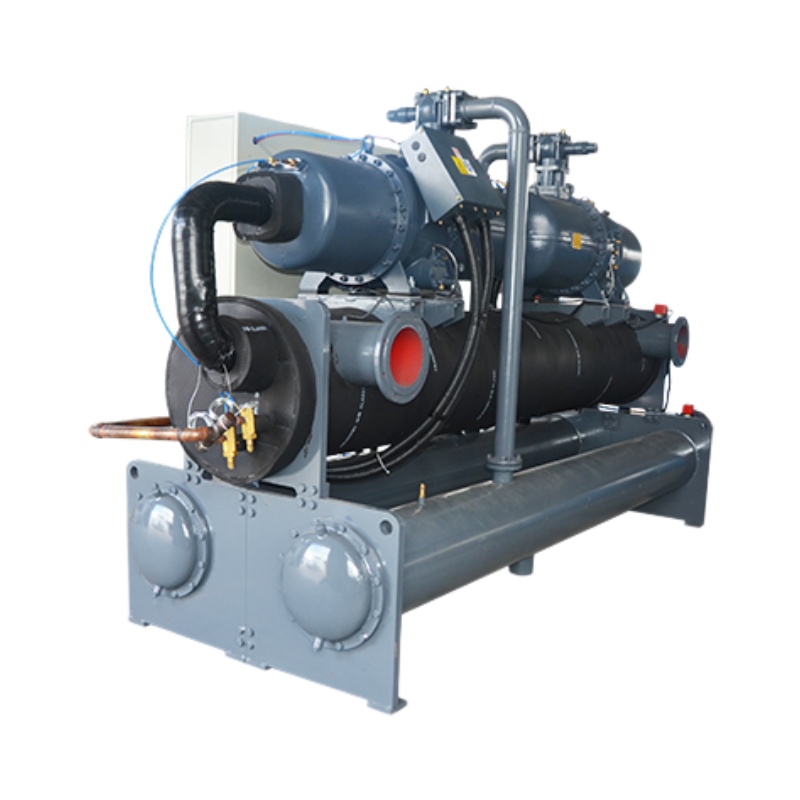
In most industrial projects, the question of whether to use an air cooled chiller or a water cooled chiller is far from straightforward. On paper, the decision may seem simple: air cooled chillers are easier to install and require less infrastructure, while water cooled chillers are more efficient and suitable for high-demand, continuous operations. In reality, the right choice depends on load, space, climate, and long-term operational considerations.
A chiller that performs perfectly in one facility may struggle in another. Misaligning system selection with real-world conditions can lead to underperformance, higher energy bills, or increased maintenance costs.
Recognizing Air Cooled and Water Cooled Chillers in the Field
Engineers and technicians often identify chillers at a glance by observing their physical setup.
Air cooled chillers are typically installed outdoors or on rooftops. They are distinguished by:
- Large axial fans mounted on the top or sides
- Exposed finned tube condensers
- No connection to external water piping
Water cooled chillers are often installed indoors, connected to a cooling tower outside. They generally have:
- No large condenser fans on the main unit
- Inlet and outlet water piping leading to a cooling tower
- A more compact footprint in the machine room
In most industrial applications, the presence of a cooling tower usually signals a water cooled system, while large visible fans indicate an air cooled system.
Why Water Availability Shapes the Choice
Water availability is often the first factor in chiller selection.
In regions where water is scarce, costly, or strictly regulated, air cooled chillers are typically the practical solution. They operate independently of continuous water supply and do not require cooling towers.
Where water is abundant and treated appropriately, water cooled chillers offer higher efficiency, particularly for larger loads. Industrial water chillers excel in continuous operation scenarios, maintaining stable performance and lower energy costs.
Cooling Load and System Scale
The size and variability of the cooling load heavily influence the selection process.
Small to medium production lines, such as injection molding machines or laser cutting equipment, can often be efficiently cooled with air cooled chillers. Their compact design and simpler infrastructure make them ideal for modular setups.
Large operations—chemical plants, pharmaceutical production facilities, or centralized HVAC systems—benefit from water cooled chillers. These systems manage continuous high loads effectively, providing consistent cooling and improved energy efficiency.
Space and Layout Considerations
Installation space is a frequently overlooked factor.
Air cooled chillers require sufficient outdoor clearance to ensure proper airflow. Without adequate space, recirculation of hot air can reduce performance.
Water cooled chillers reduce the chiller’s indoor footprint but need additional room for a cooling tower, piping, and pumps. Engineers must carefully plan system placement to balance efficiency with facility constraints.
Ambient temperature plays a subtle but crucial role in system efficiency.
- In moderate climates, air cooled chillers perform reliably and are often cost-effective.
- In hotter climates, their performance drops as ambient air temperature rises.
- Water cooled chillers maintain stable efficiency across varying environmental conditions, making them a preferred choice for tropical or desert regions.
Industry Trends and Typical Applications
Different industries tend to favor one system type over the other:
- Air cooled chillers are common in injection molding workshops, laser cutting facilities, medium-sized food processing plants, and smaller production lines. Compact design and easy installation make them attractive for modular setups.
- Water cooled chillers are often used in chemical and pharmaceutical plants, large centralized HVAC systems, and extensive food processing facilities. Their stability and efficiency suit continuous, high-demand operations.
- Hydroponic water chillers are increasingly adopted in agricultural applications where precise temperature control of nutrient solutions is critical.
How the Systems Work
Both air cooled and water cooled chillers operate on the same basic refrigeration principle: refrigerant absorbs heat from the process and releases it to the environment. The difference lies in the medium used for heat rejection:
- Air cooled chillers release heat directly into the surrounding air using fans and finned tube condensers.
- Water cooled chillers transfer heat into water, which is then cooled via a cooling tower. This additional step enhances efficiency but requires more infrastructure, including pumps and water treatment.
Component Overview
Air cooled chiller systems generally include a compressor, evaporator, finned tube condenser, and fans.
Water cooled chiller systems add shell-and-tube condensers, cooling towers, pumps, and water treatment systems. More components mean higher efficiency potential but also increased maintenance complexity.
| Factor | Air Cooled Chiller | Water Cooled Chiller |
|---|
| Energy efficiency | Medium | High |
| Initial cost | Lower | Higher |
| Operating cost | Higher | Lower |
| Maintenance | Simpler | More complex |
| Noise | Higher | Lower |
| Space footprint | Moderate | Larger (including cooling tower) |
Choosing between air and water cooled systems often involves balancing initial investment with long-term operational costs.
Making the Right Choice
There is no universal “better” system. The decision should be guided by:
- Availability and quality of water supply
- Actual cooling load and operational hours
- Space constraints for installation
- Climate and ambient temperature conditions
Generally, air cooled chillers provide a simpler, faster, and flexible solution, while water cooled chillers excel in efficiency, stability, and large-scale continuous operations.
JECICOOL’s Approach
After providing industrial chillers to factories across injection molding, laser processing, food manufacturing, chemical production, and hydroponic agriculture, JECICOOL has observed that the optimal chiller is rarely the most expensive or technically advanced. It is the system best suited to the site’s specific operating conditions.
By understanding load requirements, environmental factors, and space constraints, engineers can design air cooled or water cooled chiller systems that deliver reliable performance and efficiency for years.